The Never-Ending QB Search: How Denver's Quarterback Carousel Became the Most Expensive Ride in the NFL
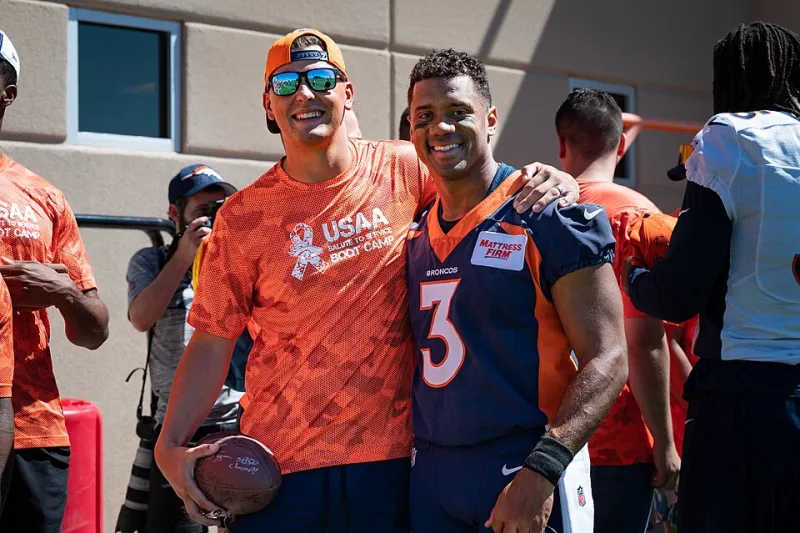
Photo: Senior Airman Danielle McBride, Public domain, via Wikimedia Commons
Let's just say it out loud: being a Broncos fan in the post-Elway era has required a very particular kind of emotional flexibility.
You've had to get excited about quarterbacks who turned out to be placeholder guys. You've had to talk yourself into reclamation projects. You've had to watch franchise-level money get committed to players who were, at best, bridge solutions and, at worst, expensive lessons in organizational wishful thinking. You've done all of this while watching Patrick Mahomes exist in Kansas City, which is its own special category of painful.
Since Elway's retirement in 1999, Denver has suited up more than 20 different starting quarterbacks. Twenty-plus. That's not a quarterback situation — that's a revolving door with a salary cap attached to it.
The Numbers Don't Lie (And They're Pretty Brutal)
Let's put this in perspective with some context that hits differently when you see it laid out plainly.
The Kansas City Chiefs have started two quarterbacks in that same general timeframe — Alex Smith and Patrick Mahomes. Two. The Green Bay Packers went from Brett Favre to Aaron Rodgers with barely a hiccup in between, maintaining competitive relevance for three-plus decades on the strength of positional stability.
Meanwhile, Denver's quarterback spending over the past two-plus decades reads like a financial thriller with no satisfying ending. The Russell Wilson deal — four years, $242 million — became one of the most scrutinized contracts in recent NFL history when the partnership collapsed spectacularly after just two seasons. The Broncos ate enormous dead cap money to move on, financial damage that rippled through the roster-building process in ways that fans felt on the field every Sunday.
Before Wilson, there was Case Keenum, Joe Flacco, Teddy Bridgewater, Drew Lock, and Paxton Lynch — a rotation of starters that covered nearly a decade and produced exactly zero playoff victories. Each transition came with its own costs: roster disruption, offensive system overhauls, and the kind of organizational uncertainty that makes it genuinely hard to recruit and retain complementary talent.
What the Carousel Actually Costs Beyond the Money
Here's what gets lost in the contract number conversations: the cultural and psychological cost of constant quarterback instability is just as damaging as the financial one, maybe more so.
When a franchise cycles through quarterbacks at Denver's pace, it doesn't just affect the offense. It affects how the entire organization operates. Offensive coordinators get hired and fired on the strength of one quarterback's performance. Wide receivers develop chemistry with one starter only to spend the offseason learning a new system. Running backs and tight ends adjust their games to fit a new signal-caller's preferences. The ripple effects are enormous and largely invisible in the box score.
Fan engagement takes a hit too — and we say this as people who run a fan community, so we've seen it firsthand. There's a difference between the energy in Broncos Nation during the Elway years, or even during the Peyton Manning window, and the energy during a season when the starting quarterback question is genuinely unsettled heading into Week 1. The investment fans make in a team is deeply connected to believing in the person under center. When that belief isn't there, the whole emotional ecosystem changes.
"I've been a season ticket holder since the early 2000s," one longtime member of our community shared in a recent forum discussion. "And I can tell you that the vibe in Mile High is completely different when fans believe in the quarterback. It's not even close. The stadium is louder, the tailgates feel different, the whole thing has more energy. We've had maybe three or four seasons since Elway retired where I genuinely felt that way."
Three or four seasons out of more than twenty-five. That's a painful ratio.
The Pattern That Keeps Repeating
So how does a franchise end up here? And more importantly, why does the pattern keep repeating?
Look at the decision-making around each quarterback transition and you'll notice something consistent: Denver has repeatedly prioritized short-term solutions over long-term development. When a quarterback struggled, the organization moved on quickly. When a veteran became available — even an aging or declining one — Denver was often in the market. The front office has historically shown more patience with the idea of finding a quarterback than with actually developing one.
The Drew Lock experiment is instructive here. Lock showed enough flashes in his first season to generate genuine optimism, but the organization's commitment to him always felt conditional. When the Stafford trade became available in 2021, Denver pursued it aggressively — only to lose out to the Rams, who then won a Super Bowl with him. The Broncos responded by swinging even bigger for Russell Wilson, and we all know how that movie ended.
The throughline isn't bad luck. It's a decision-making pattern that prioritizes the appearance of solving the quarterback problem over the patient, often unglamorous work of actually solving it.
What Would It Actually Take to End This?
Honest answer? Probably a combination of things that don't often align perfectly.
First, it takes drafting a quarterback and genuinely committing to his development — not as a bridge, not as a backup plan, but as the long-term answer. That means building an offensive system around his strengths, hiring a coaching staff with a track record of quarterback development, and giving him the runway to grow through early struggles without immediately reaching for the next available veteran.
Second, it takes front office continuity and patience — two things that are genuinely hard to maintain in a results-driven league. The pressure to win now is real, and it's applied from ownership down through the fanbase. Resisting that pressure long enough to let a young quarterback develop requires organizational alignment that Denver hasn't consistently demonstrated.
Bo Nix represents the current bet. The 2024 first-round pick showed legitimate promise in his rookie season — more than most people expected, frankly — and the early signs suggest the organization is treating this differently than past quarterback situations. The offensive infrastructure being built around him, the patience shown through early growing pains, the coaching staff's public commitment to his development: these are encouraging signals.
But Broncos fans have been encouraged before. We know how to temper hope with hard-earned skepticism.
The Mile High Faithful Deserve Better — And They Know It
What's remarkable about Broncos Nation, honestly, is how durable the fanbase has been through all of this. Twenty-plus starting quarterbacks, billions of dollars in contracts, years of missed playoffs — and Mile High still sells out. The community here keeps showing up, keeps debating, keeps caring deeply about a team that has made caring deeply into something of an endurance sport.
That loyalty deserves to be rewarded with organizational decisions that prioritize long-term stability over short-term fixes. It deserves a front office that learns from the pattern instead of repeating it. And it deserves a quarterback who's still starting games in orange and blue five years from now.
We're not asking for Mahomes. We're just asking for someone we can believe in for more than two seasons at a time.
Is that too much to ask? Drop your thoughts below. And if you've got a hot take on whether Nix is the real deal — we're ready for that debate.